The Gambler and his Cowboys: A Netflix documentary review of Dallas’s glory and decline
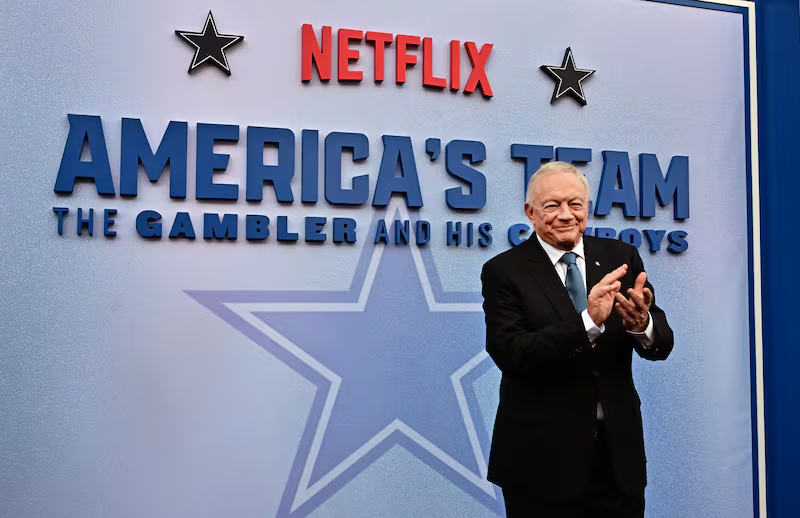
The Dallas Cowboys, the NFL’s most storied and valuable franchise, reigned supreme in the 1990s, their star-emblazoned helmets a symbol of gridiron dominance. With three Super Bowl triumphs in four years, they weren’t just a team, they were a cultural juggernaut of America, known for their flair and ferocity.
Netflix’s recent documentary series: America’s Team: The Gambler and His Cowboys dives into this golden era, spotlighting Jerry Jones’s audacious gamble to resurrect a fading dynasty and offering a sharp lens on why that brilliance has since dimmed.
The series kicks off with Jones’s 1989 purchase of the Cowboys for a then-record-breaking $140 million—a deal that redefined NFL economics. At the time, Dallas was a shadow of its former self, limping to a 3-13 record in 1988 under the revered but embattled coach Tom Landry. Jones, an Arkansas oilman with plenty of nerve, didn’t just buy a team; he staked his fortune on a vision of what his franchise would ultimately become. Through the documentary, the story captures this high-stakes moment vividly, using archival clips and insider interviews to frame Jones as a disruptor in a league rooted in tradition.
His boldest move? Sacking Landry, a 29-year veteran with two Super Bowl rings, and installing his University of Arkansas teammate, Jimmy Johnson. In short, the decision sparked outrage. Fans burned jerseys, pundits cried foul, and the NFL old guard recoiled. Yet, as the series reveals, it was this upheaval that set the stage for a dynasty.
Through gripping storytelling, The Gambler and His Cowboys chronicles how Jones and Johnson rebuilt Dallas into a juggernaut. The core draft picks of Troy Aikman, Emmitt Smith, and Michael Irvin, paired with Johnson’s innovative, high-octane coaching, helped to deliver Super Bowl victories in 1992, 1993, and 1995. The series doesn’t shy away from the era’s excesses: the off-field scandals, the rock-star swagger, and the simmering tension between Jones’s showmanship and Johnson’s discipline. Their 1994 split, driven by Jones’s need for control, is portrayed as a turning point – not just for the team but for the franchise’s trajectory. Barry Switzer’s 1995 title, built on Johnson’s foundation, marked the last gasp of Dallas’s dominance.
What makes this documentary essential is its unflinching look at the Cowboys’ struggles since those heady days. With only four playoff wins since 1995, Dallas has become a paradox: a $9 billion behemoth that’s more spectacle than success. The series ties this to Jones’s unrelenting grip as owner and general manager, a trait that fuelled the 1990s rebuild but now stifles progress.
Interviews with current players and analysts highlight how his penchant for splashy signings, reluctance to empower coaches, and focus on brand over results have left the Cowboys stuck in a cycle of hype and heartbreak. From Dak Prescott’s contract disputes to defensive inconsistencies, the parallels to Jones’s earlier clashes with Johnson are striking. The documentary suggests that his instinct, once a catalyst for revolution, has become a liability in an NFL that demands adaptability and collaboration.
America’s Team: The Gambler and His Cowboys is another masterclass by Netflix in sports storytelling, blending nostalgia with a sobering autopsy of Dallas’s decline. While not demonising Jones’ character for today’s NFL, the series presents him as a visionary whose strengths and flaws are two sides of the same coin.
For UK fans like tuning in via late-night games often featuring the most marketable teams, it’s a reminder of why the Cowboys remain the NFL’s most compelling saga, glorious in their prime, maddening and often humouring in their current stagnation. The lesson? Bold decisions can forge empires, but without humility, they can’t sustain them.


